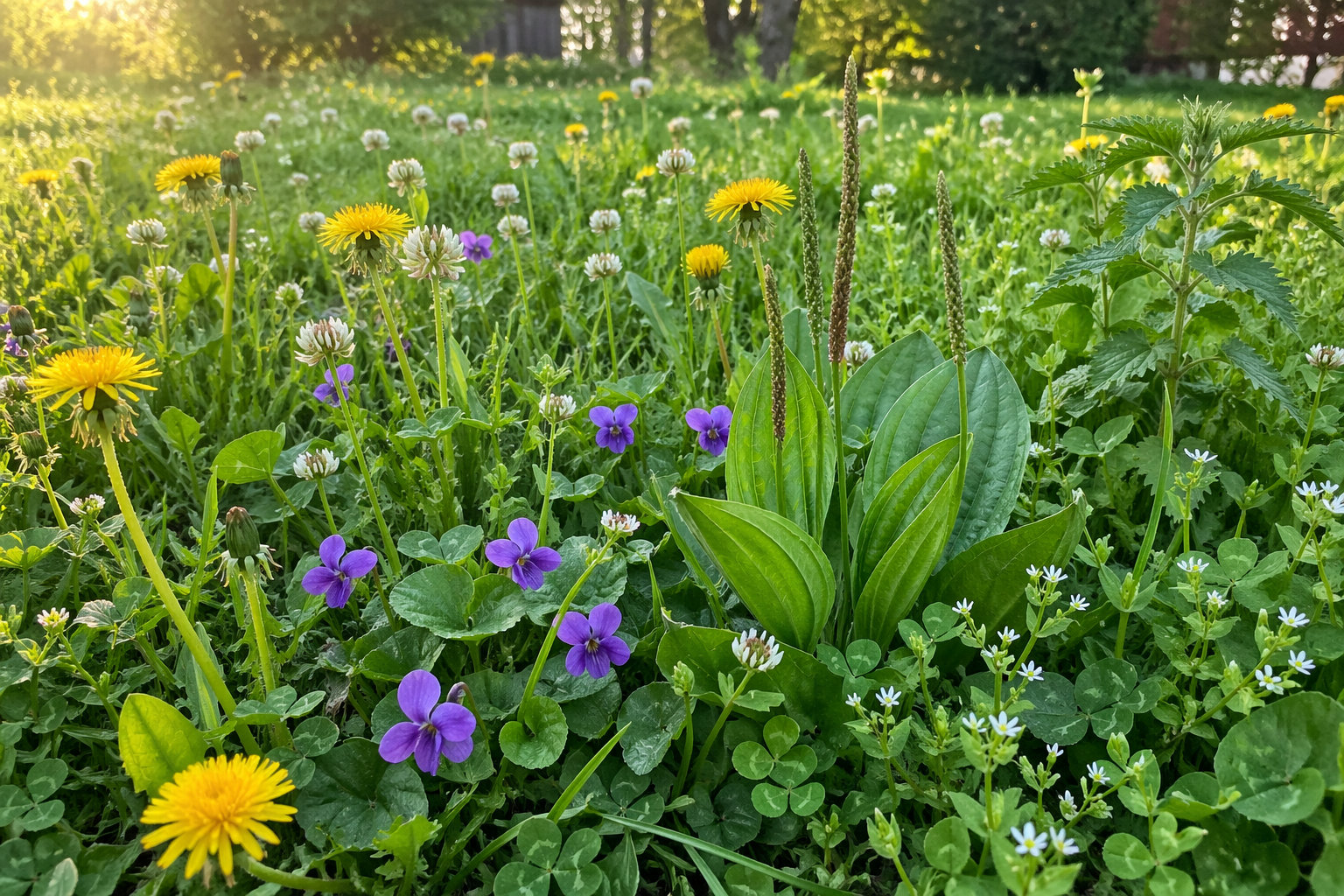
Every spring, the same plants rise first.
Dandelion. Plantain. Clover. Violet. Chickweed. Nettle. Mullein.
For many people, that’s the signal to reach for chemicals.
For me, it’s the signal to look closer.
Because my yard is full of medicine most people spray away.
These are not random nuisances to me. They are some of the most useful plants growing here. Dandelion and plantain are two of my everyday go-tos. Violet and chickweed are gentle but powerful. Nettle and mullein ask for careful handling, but they give a lot in return.
I protect them because I know what they are.
And I think we’ve lost something important by forgetting that.
We’ve Been Taught a Perfect Yard Is a Lifeless One
Somewhere along the line, many people were taught that a “good” yard means uniform grass, no clover, no dandelions, no surprises, no wildness, no useful plants unless they came from a nursery pot with a tag in it.
I’ve never understood that.
Yes, we mow. Yes, we keep things managed. But I also welcome useful herbs and flowers where they naturally appear. A living yard makes more sense to me than a sterile one.
Too often, people spray first and ask questions later.
They see green in the lawn and immediately treat it like the enemy.
Meanwhile, they may be killing plants their grandparents would have gathered for tea, salve, stings, cuts, coughs, or spring nourishment.
How Much Are We Actually Spraying?
U.S. homeowners use enormous amounts of lawn and garden pesticides each year in the pursuit of a flawless green carpet. Herbicides make up a large share of that use, with products designed to wipe out broadleaf plants like dandelion and clover.
That tradeoff deserves more thought.
Because what gets called “lawn care” can also come with costs to families, pets, pollinators, soil life, and water. Children and pets are especially vulnerable because they play close to the ground, track residues indoors, and come into frequent contact with treated surfaces.
Pollinators pay too. The same early flowers people rush to eliminate are often the first food available for bees and beneficial insects when little else is blooming.
The Bees Know What’s Valuable
One of the reasons I refuse to spray is simple:
I care about what depends on those plants.
Dandelions and clover feed bees early in the season. Violet and chickweed support biodiversity. A yard with life in it supports more life.
And sometimes the plants we didn’t intentionally plant become the most important ones.
We had milkweed show up near our pampas grass, and the Mr. left it there because he knew why it mattered. Milkweed is essential for monarch butterflies. Without it, monarch caterpillars cannot complete their life cycle. Its flowers also provide nectar for bees, butterflies, and other pollinators later in the season when many blooms have faded. That one “weed” can support an entire little ecosystem.
What These Plants Offer Us Too
Many of the plants we dismiss today were once common household knowledge. People knew what to gather and how to use it.
They reached for plantain on stings and bites. They used dandelion as food and tonic support. Violet and chickweed were valued for gentle skin and seasonal uses. Nettle was respected for nourishment. Mullein was known in traditional herbal practice for respiratory support.
This knowledge wasn’t strange.
It was normal.
I’m Not Saying Never Manage a Yard
I’m not saying let everything grow wild.
I’m not saying eat random plants without learning proper identification and safe preparation.
I’m not against modern medicine when it’s truly needed.
And I’m not saying every self-seeded plant belongs exactly where it pops up.
I’m saying pause before you spray.
Learn what’s growing there first.
Because not every plant in your yard is a problem.
Some of it may be food.
Some of it may be medicine.
Some of it may be feeding bees.
Some of it may be healing the soil.
Some of it may simply deserve more respect than we’ve been taught to give it.
Before You Kill It, Know It
We’re spraying medicine like it’s the enemy, throwing away free herbal remedies and wondering why we feel disconnected from the very things meant to help us.
That never made sense to me.
So I’ll keep choosing a living yard over a perfect one.
And I’ll keep looking closer before I reach for anything meant to kill.